Sunday, November 3, 2013

An angel’s day

Jill was was rolled about in a sweet dream. A dream most cherished by her. How it could not be when her darling Juno comes as a hero in it!  Kisses, cuddles, and the most enchanting of all – his licks all over her silky neck... From a flower-covered romantic cliff, Jill was about to fall when Juno suddenly saved her by biting at the back of her neck. While carrying her like a mother cat doing with her kitten, Juno passed this advice to her, “When you fall from heights, learn to land on your feet”. She should have spent her remaining life in that dreamland unless madam Genna had shouted “Jill come on”. At that commotion she woke up, made a gymnastic-like body stretch and walked fast to the dining room. There her breakfast was ready, not on the table, but as usual down on the floor at a corner. To be truthful, the plate was clean and it carried a lavish course of ‘Injera’ and some pieces of bones with a little or no flesh attached. Though it was a Cinderella-like life, after food, Jill never had to wash the plates; nor her hands before a meal. Washing is untold in a cat’s life, however pretty he or she is.

Image courtesy: http://www.bhmpics.comngels.com 
As a pet cat, Jill’s world in that bungalow comprised of three things – attic, a corner in the dining room and a sprawling yard. And rarely, she should be obedient on the lap of madam Genna’s grandson, a fatty Birhanu. If the attic provided her the warmth of dreamy naps, the dining room fed her enough. The sprawling yard enlightened her intellect with sights – horticulture gardens, birds, grass, grasshoppers, geckos, chameleons adept in camouflaging and so on. A thick hedge of thorny plants that seasonally bore bright yellow fruits bordered the lawns. 

Birhanu comes to visit his grandmother once or twice in a month, only after an email or mobile text that should leave madam Genna shouting in excitement. She would first shout in glee and then start clattering vessels making the tastiest dishes for her loving grandson. Such occasions are a matter of gourmet’s delight for Jill, too. 

One-year-old Jill is already a beauty cat. She’s already under the scanning eyes of her male counterparts. She knew it, but found none suiting to her sweet imagines. It continued so until she saw two eyes, sharp and shining as precious stones. For a day or two those beautiful eyes continued staring at her from the other side of the hedge. When she strolled on the lawns; the eyes moved in tandem.  When the outsider gestured his love invite, Jill fell flat. 

She, for the first time, breached madam Genna’s code of conduct and squeezed out through the thorny gaps of the hedge. When the lovers saw each other, birds chirped, a wind blew gently, flowery bushes waved and there rained romance... Their velvet-like bodies shined. Jill felt timid... how masculine he is! He had a rough mustache .. hairy body, brawny limps... to sum up, a roughness that is handsome.  “What...what’s your name?” Jill asked. “I’m Juno. Do u like my name?” “You are irresistibly romantic member of the great cat legion” Jill said inside her mind before uttering, “You are nice”.  
Image courtesy: http://www.allposters.be

Soon Jill and Juno became remarkable lovers among the cat community of the village. When they looked at each other, the cupid sent arrows of romance; when they walked together, the moorlands got a sheath of flowers; when they hugged each other, the sky turned yet more bluish. Between cats, there won’t be a formal marriage ceremony, but things happen in their normal course. And staying together won’t also be a pastime, except regular visits between the couple. Everything was going on smoothly until that challenge came into the fore. 

A great challenge in their life appeared in the form of three wild dogs. The dogs would prevent Juno from crossing the road and meeting Jill. Once or thrice Jill had to take risky endeavours to save Juno from the dogs. At Juno’s cry which is a secret code, Jill would run to him distracting the attention of the dogs and in no time Juno along with Jill would dash to madam Genna’s home. And that worked. 

It was a Monday. As usual the devil-like dogs locked Juno under their custody. Juno was seen helpless and not defending, but sitting standstill with his head bent down. Sheer fear was dooming him. Juno gave a groan – the secret code to Jill. At the attic, Jill’s ears immediately received the distress call. In no time she darted to the usual door, but it was closed! Oh My God! Madam Genna is shouting in joy... she must have got a text from her grandson... It seems she would open the door not now... Panicked Jill ran here and there inside the bungalow before darting out through the front door. “It’s late Jill... It’s late! Run fast and save Juno from the brutes” she whispered herself. She saw nothing except her sweetheart arrested by the wild dogs. 

“Go fast, distract them...” her mind hurried. Jill became a bullet... she pierced across the highway. It was like an angel flying for saving her lover! A speeding omnibus approached when Jill adeptly darted through between the fore-wheels and rear wheels. The driver gestured in relief for not hurting the animal. There was a sudden ‘thud’ sound... oh, no... Jill is thrown into the air... she is hit by one of the rear wheels... She fell over the grass on the side of the road. "...stand on your feet", she recollected what Juno had told her in that dream...struggled a lot to stand on her feet.. but could not.. inside, her innocent heart throbbed for her sweetheart... outside, her pristine white body is thoroughly smeared of blood... consciously or not, she wagged her tail hardly twice – is it her fury against the dogs? People came running. Dogs ran in fear. Juno was released. Before he reached, Jill became still on a puddle of blood – an eternal rest.  Juno looked skywards. Jill must be one among the angels.

Entire village was doomed in worry at this early morning mishap. People who were going to local market, who were collecting water from the public tap, who were taking a coffee from the nearby restaurant, who were jogging on the roads... all said in one voice: “Oh what a bad day!”. As in Juno’s heart, Jill had a place in people’s hearts, too.  
- K.P. Sivakumar

Sunday, October 27, 2013

A letter to Houdini

Harry Houdini (March 24, 1874 - October 31, 1926)

My dear Houdini,

Writing from the Earth.  We don’t know where you are now, but know that you have proved before your sweetheart Bess that there is no rebirth for a dead. When you didn't come back on the séance to utter “Rosabelle believe” in Bess’ ears, the entire world understood the futility of séances. 

As a 4-year-old, clinging on the hands of your parents, you left the shores of Europe to cross the Atlantic seeking better life prospects. And that real-life escape worked. In the USA, your new homeland, you started receiving applause. You grabbed everyone’s praise not only as a trapeze artist, but also as an ever-winning marathoner.

It must be some celestial destiny that should have prompted you to take up the magic wand. When you got the sobriquet ‘King of Cards’, it was just a fitting start. Later you opened a path of your own. You carved out a niche which until then was unheard in magic. When you outdid a handcuff for the first time, you got the name, ‘King of handcuffs’, concomitantly, the world of magic was gifted with a new horizon. That domain, which we term ‘escapology’, has made the art of magic undaunted and ageless. 
  
In front of your radical thinking no superstitions survived. Setting aside lucrative show schedules, you devoted yourself as ‘ghost buster’ and eradicated false beliefs in the society. You lived just 52 years and what you did in magic is still evergreen. At New York’s Machpelah Cemetery, in front of many wet eyes, you made a clam conclusion for this worldly life. 

Your lineage is today flourished with deft descendants  who walk through your daring paths. They strive for the posterity of your beloved art. If you live as David Copperfield in the USA; in the UK, you hover over a gracious Thames as a David Blaine  Down south of Asia, you sprinkle golden spangles of wonder over ‘God’s own country’ through the graceful Gopinath Muthukad. We see in them and myriads of their counterparts, the glitter of veneration and tribute for you, their master. Thus you live with us.

Oh... something about us, if you are keen to know.  We are now contained in a world that has become a straitjacket. You migrated to the USA in 1878 and the world migration is still continuing. Some countries lament about ‘brain drain’; my country is no exception. But many like me surprise why they are not keen in filling vacancies on time and providing legitimate wages for keeping the ‘brains’ inside the country! 

Since 1990 onwards countries are caught up in the spider web of GATT and GATS. The former is a so-called world agreement for making trade tariffs uniformly beneficial for all countries. But in reality, the regulations ensure the perpetuation of developing countries. I am not sure whether the Grace Hospital of Detroit was really graceful for you or not. But today no hospital wants to be really gracious to patients. They are also under stiff pressure due to international commercial competitions. Thanks to the GATS that has mercilessly put even education and medical service under global rule. Education system has deviated a long way from its declared and widely believed norms. Today is ‘you pay, you take’, even in education.  

Dear Houdini, no country can try to escape from this spider web and make its own attempts of resilience. The world system is such that there are certain core countries that allow the periphery nations to revolve only at particular distance. Any attempt to break this may soon invite global sanctions. It’s called globalization!

You told stone walls do not a prison make... But it seems so-called international treaties not only build prisons but lock world's population in lockups. 

Our pray all the time is that one day one Houdini may appear and liberate the whole world from the straitjackets of agony to establish an egalitarian, welfare-for all world! 
Consider if you can reappear, please. 

With lots of love,
Your fan

Sunday, October 20, 2013

When you call me a donkey

Donkey means not fool but a tool for progress. (Photo courtesy: www.animalpictures123.org)

Till three years before a donkey to me was just an animal having no brain, no commonsense or no readiness to work. In India, my lone encounter with donkeys was while climbing up and down the Sabari hills as part of annual pilgrimage. Then herds of donkeys carrying heavy loads on their back and led by some keepers would be jostling and chocking the pilgrim paths causing disturbance to devotees. Tired of a tedious mountain climb, devotees disdained the donkey population. 

Now for the last three years, I am seeing a different face of donkeys. Ever since I landed Ethiopia, donkeys became more and more familiar. Here not a single day I miss seeing a hardworking donkey.  Donkeys near my home carry everything on their back – it can be vegetable sacks, firewood, grains or even jerrycans of water. They show their stamina also by pulling carts. 

Donkey economy
I could hear that in the suburbs of Addis Ababa, the capital city, many people make a hefty income out of their donkeys. Donkeys toil and moil carrying commodities to the city and back producing money to an extent of 500 ETB (Ethiopian Birr) per day for their owners.  I just googled and found many research papers substantiating the considerable economic agency possessed by the donkey population. Some documents avow the supremacy donkeys enjoy in safeguarding the economy of rural and semi-urban societies through developing societies around the world. 

Donkey beauty 
If I say donkeys have good complexion, don’t be annoyed. Be patient. Enjoy watching its sinewy, skinny bodylines and perfect eyes. To know its devoutness to duty, you should really own a donkey.     If not for me and you, doing one’s duty is the beauty for donkeys. Donkeys are not fools that do not understand what you do on it. With a single kick by throwing its rear legs together upward, a donkey can put an end to a living creature that tries to attack it. Still, in front of its owner, donkeys become synonym to obedience.

Donkey history
In the annals of history, donkeys occupy many coveted thrones. They have been here ever since 5000 BC. Many stories have been jotted down by known and unknown writers. Aesop an author of the yesteryears believed to be an Ethiopian or Greek, has written fables on donkeys. One of his tales is about a father and son travelling with a donkey. As the passersby comment, either father, or son or both together climbs up the animal. Again at the influence of the passerby, they got down and carried the animal together on their shoulders. Both the father and the son had no stand of their own, but obliged what others say. Fed up by this drama, the animal kicks down both of them. I don’t know what prompted Aesop to conclude the story in such a way that the donkey accidentally falls into water and dies. Here, donkey cannot be called a fool for sure. 

Thanks to Prof. M.I. Zuberi who during many morning walks unravelled many truths on the modest animal. Calling donkey is one of the most derogatory addresses to insult a person. “You are a donkey” equals saying that “you are the most obnoxiously foolish, lethargic and idle”. Here is my latest objection. Here in Ethiopia I see the yeoman donkeys that bear unblemished strength, sincerity, obedience and wisdom. Here are the donkeys that serve as money banks for its owner. Here are the donkeys that have earned an inseparable space in the social fabric. So, definitely, next time when you call me a donkey, I should keep a smile.  
- K.P. Sivakumar

Sunday, October 13, 2013

Take a reverse: Devinder Sharma's call to policy makers

For the first time I saw Devinder Sharma on 5th of October. Thanks to the international eco-meet, ECOCASD 2013 that brought the great personality to Thiruvananthapuram. The acclaimed food policy analyst, writer and thinker was there to give valedictory address. Over five hundred delegates were eagerly waiting to hear from him on the essentials that a country like India need for saving ecosystem and continuing with sustainable development. To my fortune I got an opportunity to chat with the erudite scholar in forenoon itself.

Having a towering image in the sphere of world’s paradigms on biodiversity, agriculture and food security, Mr. Sharma would grab anybody’s heart by being down to earth. He is clear in words and firm in opinions. Following is a gist coined out of a brief, but enjoyable chat with the generous thinker and activist. 

Food security? Is it surplus food, cheep food or optimum food? All are incorrect. Food security is actually availability of food for all at all times of need. 

Needed for countries like India? It is high time to have a strong policy shift at the apex. The policy makers should take a positive deviation from the existing routes to effect better changes at the grassroots. This can alone bring in progress in the areas of agriculture and food production. 

What is the existing paradigm? Today the world is driven by the motto of economic growth and technicalities of GDP. These could never value the importance of ecosystem conservation. This conference (ECOCASD 2013) is upholding the theme of ecosystem conservation and sustainable development. I would say, the realization of sustainable development through ecosystem conservation can be made only with a paradigm shift at the top. Today is of prolific exploitation of the natural resources. Natural resources should be seen not as a commodity as is being done today. 

Salient features of ‘economic growth’ model? Conspicuous feature in India is that more rural people are prompted to drift to the urban for making a living. Industry is given priority and agriculture is discarded. This leads to the death of our age old village agricultural systems. We need a reverse of the system. People should be encouraged to remain in their villages for pursuing the farming. Gandhiji’s preaching of ‘production system by the mass and not for the mass’ was significant at this juncture. Refugee mentality of a government serving food to its people can be replaced only through adopting the path shown by Gandhiji, where people love doing agriculture and produce the food needed for them.

Then world regulations? It’s interesting. US farming bill of 2013 provides 307 billion dollars of subsidy to its farmers. Fact being this, it is ironical that the WTO pressure countries like India to cut farmer subsidy. Tomorrow (06 Oct) the chief of WTO is visiting India with an objective of the above said and many. Pressure is persistent. 

Leaders like you voice time and again. Do you see any impact over authorities? Sure. There is change. In front of such persuasive demands as we do, they cannot simply act blind. For example the chief of the UN, Ban Ki-moon has called for a rethinking over the effectiveness of existing policies. How could they not make a retrospective since the truth remains radiant that even after long span of economic growth race, majority of problems could not be solved including poverty and gap between the poor and the rich. 

While concluding the chat, with a captivating smile Mr. Sharma reminded Laxmi Presanna a leading journalist who was there, not to forget writing on the possible aftermaths of the next day’s visit of the WTO chief. 

Saturday, October 12, 2013

Ethiopia’s ‘Mengi’ mesmerised at Kerala sights

[This was one among the press releases flew from the media centre of recently concluded II ECOCASD 2013 International confluence.]

Mengistu Tulu Balcha near Sri Krishna character of a Kathakali programme during a cultural evening of ECOCASD 2013 International Conference held in Thiruvananthapuram, Kerala. 
Thiruvananthapuram: 33-year-old Mengistu Tulu Balcha is thoroughly astonished at the sights of ‘God’s own country’. Inside a landing aircraft over airport here, Mengi felt as if down there, the blue sea was embracing a green paradise. When he knew that it was the canopy of lavishly growing coconut trees that gave such green look from above, curiosity in him only grew. 

Nowhere in Mengi’s Ethiopia could one see a coconut tree. Coconut, its husk, shell and kernel are all weird enough for this African youngster. 33-year-old Mengistu - ‘Mengi’ for his close pals and family members – came to the city for attending the ECOCASD 2013 international meet. Mengi works as a Lecturer with the English Department of Ambo University. 
He reached India three months before for joining an orientation course at the Hyderabad-based National Institute for Micro, Small and Medium Enterprises. Thanks to a scholarship granted by the Indian government. It was from Hyderabad that he flew to hiruvananthapuram. At the ECOCASD 2013 venue, awaiting him were several photos of his homeland at an exhibition. Photos of Ambo’s village life, Wenchi crater lake, favourite ‘Injera’ served with raw meat... all these were enough to turn Mengi nostalgic.

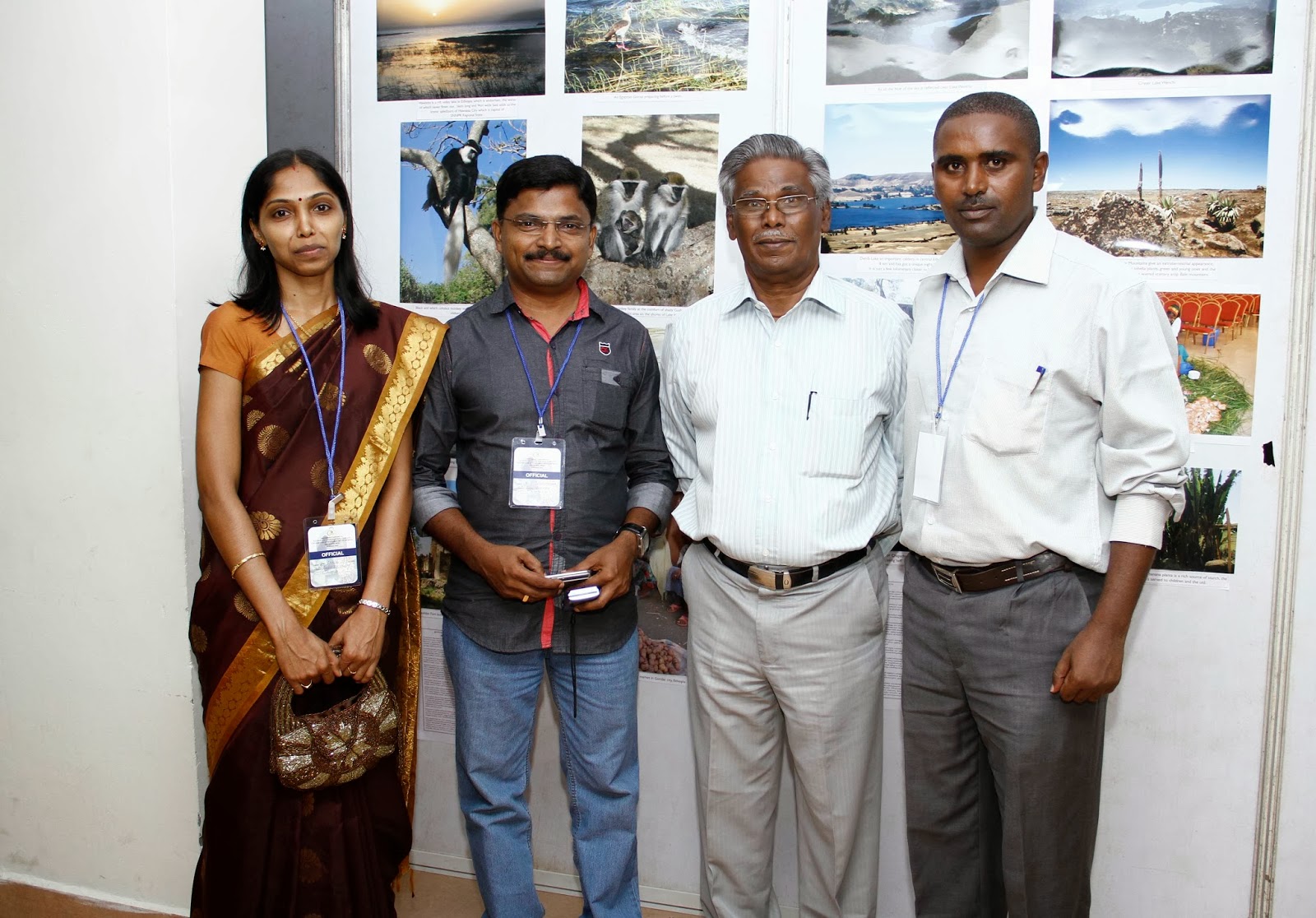
Photos speak: At the exhibition of Ethiopian photos, Mengi joins the organizing committee chairman of ECOCASD 2013, Prof. P. Natarajan (second right), K.P. Sivakumar whose photos are on display and Dr. Akhila S. Nair. 
Mengi is not bad in fast-paced neck-dances of Ethiopia. Still, on the starting night in Kerala, he was dumbfounded by the Duryodhana Vadham Kathakali performed by Kalamandalam Krishnaprasad and team. Captivating him was the throbbing traditional percussions of Kerala’s famed folk art. The characters of the play - smiling Krishna, strong Bhima, spiteful Dussassana and cruel Duryodhana - were all leaving Mengi breathless. Though eating raw meat is a pride custom for any Ethiopian, Mengi was taken aback at the grotesque sight of Bhima pulling out the blood smeared intestine of Dussassana. Immediately after the play, Mengi sneaked into the green room and managed many snaps with Sri Krishna.
He has also made an oral presentation on communication and small scale entrepreneurs at the ECOCASD 2013. After attending a parallel seminar on Biodiversity at Sree Ayyappa College for Women, Nagercoil, he had a visit to Kanyakumari. At the peninsular tip, Mengi who hails from a landlocked nation saw not just one, but three seas joining together. And that definitely has become a matter of lifetime amazement for him.
The ECOCASD 2013 had over 500 participants from all over the world. Among them were renowned scientists, teachers, researchers and students. Ambo University of Ethiopia, that conducted the first leg of the event in 2011 was also backing the event.
- K.P. Sivakumar

Saturday, April 27, 2013

A Vishu vignette


Just like a magician, the day starts with blindfolding you, and later unfolds a majestic sight of everything darling to you.


(This article was originally published in the April special issue of the Vismayam Magical News, monthly organ of the Asia's first Magic Academy, Thiruvananthapuram, Kerala, India.)

Early on a cold morning you are awakened by loving elderly hands. Hesitantly you wake up but to see nothing. Your eyes are covered by cupped palms of your beloved one – that can be your parent or grandparent; or even your elder sibling. From the bed, with your eyes still covered by those loving hands, you are safely and slowly led through a perfect dark. You then reach a corner of your house where your eyes are thrown open into an awesome sight. Glittering traditional lamp glows well with multiple flames fluttering at you. Your favourite deity’s photo bears a graceful smile. Golden spangles seem to cascade from the opulent bunches of ‘Kanikonna’ flowers. Coins, clothes, fruits, vegetables and what not! There is even a mirror kept among these, to see your own face… Garlands everywhere and fragrance in the air – it’s Vishu. Just like a magician, the day starts with blindfolding you, and later unfolds a majestic sight of everything darling to you.

On Vishu day, you cannot dart into and make a regular bath. Before taking bath you should smear oil well on your scalp. After bath, of course, you are going to be clad in new dresses. Then with all reverence you approach the eldest member of the family, bow respectfully and stretch your right hand. The eldest person then blesses you, places coins and currencies on your palm and graciously pats you in expression of abundant affection. As a child to whom managing with money is untold, your eyes twinkle. Coins and currencies pour in from every elder member of the family and in a few minutes your pockets bulge and you become rich.

Now you have every right to use your money as you wish. You can buy chocolates or comics; ice-cream or popcorn. During my tenure at the Magic Academy, I could see many children buying magic kits, magic toys and magic books with their Vishu collection. Some of them later got that magic bug’s bite and became disciples at the Academy.

For my Assamese friends, Dr. Rajeeb and Deepsikha, Vishu is ‘Bihu’. If Keralites have one Vishu a year, they have three Bihus – in October, January and April. Of the three, the principal one, marking the Assamese New Year, coincides with Kerala’s Vishu. What is common is that in both states, the festival has strong connections with farming. In Kerala, the best farm products are offered to the deity, where as in Assam, lands are prepared for another farming season. In one way or the other, the day is auspicious also for many other states including Bengal, Punjab, Karnataka, Manipur and Tamil Nadu. How magical our Nation is!

Akhila and I have already got a Bihu invitation from our Assamese friends. Festivals are enticing threads tied to each human heart. Wherever on this world, hearts float like kites over the clouds of excitement, tugged by the threads of nostalgia. Festival memories prompt me to remain a child, a child for ever. This is a wonder world!
-K.P. Sivakumar

Friday, April 26, 2013

Books's Face 1: A Phoenix's call at unwanted children


Chinese Cinderella
Childhood recollections by: Adeline Yen Mah
Publisher: Pearson Education Ltd.
First published: 1999
First educational edition: 2002

Source: Library, Ambo University, Ethiopia

Courtesy: Ms. Deepsikha Saikia, who lent me the book and patiently waited for long before I return.

17th century Cinderella is an Italian. We change this notion while reading Adeline Yen Mah’s ‘Chinese Cinderella’ - a book that is not only an account of her childhood miseries, but also a handbook on Chinese history, language and literature. Mah’s self portrayal of her childhood agonies and stiff sessions of seclusion are heart rendering. Rightly, she has dedicated the 1999-published book to ‘all unwanted children’.

Adeline turns a Chinese Cinderella once her father makes a second marriage and the couple begins making an unfair distinction between the previous children and their own children. Soon after giving birth to Adeline, her mother died. Father remarries. In her life she couldn’t even see a photograph of her real mother. Consequently the little child falls prey to a superstition. The child was believed to have bad blood that must bring only ill fate to the family. This brought huge extortions and pain in the life of a budding girl. Between 1941 and 1951, i.e. from the age of 4 to 14, she had more abominable things to recollect than adorable ones.

Constantly loving Aunt Baba, gracious grandmother, Nai Nai and generous grandfather Ye Ye were shades of solace. Instead, stepmother Niang and Father only sowed seeds of pain in the tender heart. Her siblings were but miserably influenced by the malice spread by the parents.

Success, achievements and celebrations are untold for a Cinderella, testifies Adeline’s life. Love, care and consideration are exclusive rights of children, except of Adeline’s sort. Scarce privileges and salubrious life experiences are only a mirage for children like Adeline whom parents consider unwanted.

Cities of Tianjin, Shanghai, and Hong Kong have contrast differences. But all these cities gave single bitter experience for Adeline: secluded boarding life, pitifully uncared by any elder from home. No letter, no egg, no special food, and no visitor – she had nothing to expect from home. School for Adeline was thus a lone asylum of dreams and pleasures – created by her and enjoyed by her.  During vacations, while she used to be the only girl unclaimed by parents, empty dormitory beds looked like scary rows of tombs. Still, instead of getting stuck by the dismay, the little girl spends her lonely hours in libraries simply to be engulfed by King Lear-kind of Shakespeare or Sara Crewe-kind of Frances Hodgson Burnett.

Prior to a play-writing competition when a disinterested Adeline told “I’m afraid of losing”, Mother Louis suggested, “Anyone who enters has a chance. However, if you don’t enter, then you certainly have destroyed your chance before you even begin”. When she was dejected for not hearing for over six months from the play-writing competition board, Mother Louisa tells her: “Be patient. No news is good news. As long as you don’t hear, you can keep on hoping […]”. As a child, Adeline had exceptional ability to identify and imbibe from the elixir contained in such elderly words.  She was blessed with a trait to understand the ‘talisman power’ of such words. That must be the secret virtue that made her emerge as the country’s first winner in an international English play-writing competition at the age of 14 and later anchor herself on the victory stands of life. This single aspect can alone motivate readers regardless of age and sex.

While concluding her own Cinderella-like experiences, she compares herself with a Chinese Cinderella named Ye Xian whose legendary story was prevalent during Tang Dynasty of 7th and 8th centuries. Ye Xian was loathed by her stepmother, but later emerged a shining star fighting life with sheer determination, hard work and optimism. Through her book Adeline introduces the same genre of phoenix inherent in her. The Adeline Phoenix should certainly kindle a flame of determination among all unwanted children in this modern world.

Adeline has made an admirable selection from the piles of her childhood reminiscences. She could arrange those memory blocks with a cherubic care to make an impressive ‘Chinese Cinderella’. While turning page after page, readers receive an irrefutable soft touch of a petite innocent girl. Line after line, she tweets charmingly the tale of a girl child who was nobody, but later becomes somebody – story of a girl spinning herself a life of dignity and delight against rudely abrasive abashments.

As readers finish reading ‘Chinese Cinderella’, they are gifted with a treasure trove of optimism. A clear insight upon the China of 1940s and 1950s, the wars won and lost and captivating aspects of Chinese calligraphy are just a bonus.
- K.P. Sivakumar