Showing posts with label Ethiopia. Show all posts

Thursday, January 22, 2015

Thinking over epidemics and environment

This article, written by Dr. Akhila S. Nair, Asst. Professor, Ambo University, was published by The Ethiopian Herald. To read it on the newspaper's site, Click Here

An awareness campaign against Ebola in Abidjan, Ivory Coast, September 25, 2014.
Obtained from: 
http://links.org.au/node/4167
Each day unravels before me many reasons why environmental science continues to be interdisciplinary. The branch of science has got strong linkages not only with the natural science, but also with humanities and social sciences. Globalism, eco-writing, environmental laws… there is a long list of instances when there occurs a marriage between environmental science and other schools of knowledge. On the other hand, laws of the land, culture, customs, mindset of the people, new inventions, historic discoveries and technological revolutions – all continue to have due impact on our environment. 

I was just thinking of these in the wake of the current surge of epidemics. Morbidity of living organisms, in short, leads to the morbidity of the environment, too. Epidemics thwart our green dreams. Virtuous life is fostered only when members of a society is healthy and happy. Preaching about environment to a perished society won’t earn desirable results. 

With Ebola outbreak, epidemic has become a hotly debated subject world over. Epidemic means the spread of infectious disease to a large number of people or other livings within short period of time. A disease is called an epidemic if the affected population crosses the expected number of infected people in a particular area.  Ebola, HIV/AIDS, Avian bird flu, Malaria, Cholera, Plague, Meningitis etc are some of the examples. 

Ebola info-graphic obtained from: http://flashpointsurvival.com. 
Connection between epidemic and environment is intertwined. For example, according to World Health Organization, a number of manmade and natural environmental factors including water supply, sanitation facilities, food and climate change influence the chances and spreading of epidemics. In case of diarrheal outbreaks most of the time, improper environmental hygiene is the main curse.  In case of many of such epidemics like Malaria or Ebola, natural hosts or vectors play a major role in their spreading.  Climate change can either favour or suppress the spread of vectors. 

It is a well known truth that fruit bats of the Pteropodidae family are natural Ebola virus hosts. But isn’t it also a truth that when climate change, fertilizer prize and dire lack of irrigation together take a villains’ role, poor people cannot find any better food than bush meat? Any epidemic outbreak weakens the physical and mental strength of the workforce. When there is no healthy agricultural workforce, there would be a concomitant crop loss and income loss. Consequently, there will be poverty, famine and diseases. 

Epidemics of livestock and poultry have also proved decisive.  November 2014 avian influenza virus attack on ducks in my homeland, Kerala in India, was reported to have brought a loss of over Rs.125 million to farmers. Though the disease outbreak could be successfully controlled due to timely intervention of the authorities, the money lost is lost; the peace of mind gone is gone. Definitely, such times of havoc drain away one’s eco-friendly enthusiasm. The reason should not be different for some countries having high prevalence of HIV/AIDS to lag behind socioeconomic developments. 

For such epidemics like HIV/AIDS, usually the victims come under the young age groups, who constitute not only the main workforce but also the major actors for positive social change, environmental wisdom and so on. When young adults face such catastrophe, there would be consequent turmoil in economy, farming, land use and natural resource management. When life itself is eroding, who would care about soil erosion!  

At the lash of an epidemic, people are thrown to stiff poverty. Naturally, for their minimal sustenance, they start seeking some shortcuts to make money. Thus becoming rampant would be sale and consumption of charcoal, timber, fuel wood and wild fruits duly exploiting their proximate natural resources. 

When society’s establishments fail to provide timely attention, epidemic victims resort to traditional healers, who would tax indigenous plant species in the localities for medicine and income. As the exploitation crosses limits, such plants fall under threatened category. Some studies have even pointed to the increased use of timber for making coffins in most affected localities. Not only that, fake traditional healers could prove detrimental, too. 

Tips to know between flu and Ebola. Obtained from: http://flashpointsurvival.com 
There were certain findings that HIV/AIDS patients think that their lifespan is shorter and hence there is no need for any commitment to the slogan, sustainable development. This underlines the need for social counseling for enhancing optimism among epidemic victims. Another finding is that premature deaths due to epidemics have stopped transfer of certain traditional knowledge about sustainable management of natural resources. 

Thus the issue is complex. When epidemics further mar the lives of the poor, how could they be eco-prudent? One thing is clear: wide gap exists in unraveling the intricate connections between epidemics, natural environment and its resources. But let’s not step an inch back in our struggle for the wellbeing of the environment to assure the wellbeing of its members; and vice versa. 
- Dr. Akhila S. Nair

Friday, January 16, 2015

When environment becomes literally sacred

This article, written by Dr. Akhila S. Nair was published in The Ethiopian Herald of 11th January. To read it there, Click Here.

Being an environmentalist, I was always attracted by one of the social theories about origin of religions – the one which proclaims that religions originated along with the origin of ‘totems’ among aborigines. Early men revered plants, animals and natural elements as their group’s strength and protector. This led to their groping according to the plant, animal or the natural element that they worshiped. Such groups are called ‘totemic groups’ and the plant, animal or natural element is called ‘totem’. 

Social scientists have noted that the cardinal characteristic of religions is that they divide everything into sacred and profane. Sacred belonged to the divine and the profane, for our mundane life. Consequently everything that belonged to the sacred category was segregated from the profane. Thus evolved were sacred animals, sacred mountains and sacred plants. Such symbols are aplenty among religions. Hinduism, for example, has got many such symbols in its belief system. Christianity and Islam are not different. 

An impressive consequence of such sacred-profane divide was the evolution of sacred groves. Sacred groves are holy sites with rich biodiversity and traditional beliefs. Since sacred and holy, such green consortiums remain protected and preserved without anyone instructing anyone to do so. That means conservation of sacred groves easily becomes the community’s need than any environmentalist’s cry. 

Sacred groves can be part of a worship place or divine monument. They symbolize man’s gratitude to the Mother Earth for the opulent resources she has provided. They serve to be undisturbed asylums for many unknown plant and animal species. Sacred groves are rich with diverse medicinal plants, indigenous flora and fauna. Religions impose social taboos which become socially imposed restrictions. Hence the protection of sacred groves becomes the natural obligation of concerned religion’s members. Different religions along India, Japan, Sri Lanka, Madagascar, Ethiopia and Kenya have this culture of nurturing sacred groves. 

In Ethiopia
Sacred groves get their Ethiopian manifestation majorly in the form of church forests. Church forests in Ethiopia are usually small land areas considered as saintly by the local population with a church at the centre. They are endowed with diverse types of indigenous plants, animals, birds and microorganisms.  Hills along northern, southern and central Ethiopia are usually spotted with a monastery or church having in its surroundings, remnants of thick forests of the past.  Studies have identified more than 35000 church forests in the country, with their sizes ranging from 1 acre to 300 hectares. 

Photos above show the sacred forest treasure of island monasteries at Lake Tana in Ethiopia. The lake has more than 20 islands housing monasteries. Each monastery is surrounded by thick vegetation which usually people keep away from considering their sacred value. Photo: SIVAKUMAR K.P.


Some of these forests date back even up to fourth century and remain to be glaring relics of the age-old Afromotane forests.   Local people try to protect them because of religious and cultural beliefs. For example, one of the beliefs is that the church forests of Ethiopia are representations of the Garden of Eden demanding our love and care.  Ultimately, due to such faiths, chances of exploitation become minimized. 

If you search for the first indigenous initiative in Ethiopia to safeguard biodiversity, your query would end at the country’s church forests. Ethiopian sacred landscapes include mountains, water bodies and graveyards which are abode for various species of plants ranging from herbs to shrubs and trees. Such localities are also gene pools of diverse, rare indigenous species. Native sacred forests are also sources of germplasm. They remain to be efficient indicator sites of the original ecological landscape, providing excellent gateway to the study and practice of in situ forest conservation and ecological restoration. 

This author could go through a worthy case study of 2009 from Southwestern Ethiopia about the biocultural diversity of sacred sites. It shows that the biodiversity contained in small sacred forest patches of Gamo highlands could successfully withstand a prolific agricultural encroachment and illegal logging, only because it was ‘sacred’.  

Challenges
As the country is surging fast through development in diverse arenas, the pressure on the sacred groves are also furthering. Researchers have reported that because of the population growth, urbanization, insufficient implementation of land use policies, social inequality and poor monitoring of post development activities, there has been an enhancement in the exploitation of sacred sites of the country. 

Many salient features including the medicinal plant diversity of native sacred forests are yet to be studied. In Ethiopia, people depend on many indigenous medicinal plants for human health care and for veterinary purpose. Still, cultivation of medicinal plants is not yet popular. Instead, practitioners and their patients usually resort to many wild varieties of medicinal plants both in natural and sacred forests of their proximity.  

In their 2013 study, Catherine and co-researchers reported that in northern part of Ethiopia, the sacred groves were surrounded by deforested, agricultural and grazing lands.  Most of the groves had no clear fencing. Worshipers, disciples, church leaders, and grazing animals enter and leave the forests throughout the day. Many church forests were cleared and converted to coffee plantations. 

Sacred forests of Ethiopia constitute a strong link between the faith and the conservation practices. Saving sacred forests means saving precious repositories of rare, indigenous biodiversity. Since religion as a social reality could set right norms, the process of conservation becomes automatically community initiatives. Since most of the country’s population is strictly religious, church forests can easily well ingrain the ideal of environmental conservation among the worshipers. Let’s be more proactive towards our church forests and other sacred natural assets.  

- Dr. Akhila S. Nair, Asst. Professor in Environmental Science Programme, Ambo University.

Tuesday, October 21, 2014

The latecomer

(This story has got no connection with any real life situation or individual, but just the author's imagination.)

In heavy morning traffic, the Mumbai roads have started roaring in different tones. When the arteries chocked too much, there was also dooming silence intermittently. A young man in formal dress was alighting from a taxi and darting into the reception of The Oberoi. In the hurry, he couldn’t respond to a nice welcome gesture offered by the well dressed guards at the main door. 

After a quick enquiry at the reception he rushed to the elevator. Though the fragrance and music inside were enticing, the man seemed unreceptive to all. He hooked his eyes at the scrolling display. His destiny is the tenth floor. Any halt before that was intolerable. 

He just glanced at his wristwatch. It’s 11am. Exactly the time told for him to face the interview board. The door was opened and a young beautiful executive popped out and tweeted, “Mr. Ramkumar Mukhopadhyay, please!”  “I’m here”, the man replied, hiding his embarrassment under a deliberate smile. Inside, a secretary was sitting with displeasure on his face. “Good morning Sir! Sorry to tell that you are late by two and a half hours. We have been trying at your mobile, but that was in off mode. The board could but get a confirmation from the airport that you have landed; and from your hotel that you have already left for this place. Please leave your credentials on my table for a usual verification”.

Late by two and a half hours! While boarding the flight previous night from Addis Ababa, his smart phone and wristwatch were set to Ethiopian time which was two and a half hours behind the Indian. Wiping with kerchief a drop of sweat that was rolling down the right side of his forehead, Mr. Mukhopadhyay submitted his credentials at the table. “Now get in for the interview, Sir. Best of luck!” the young executive replied smiling. 

Ramkumar Mukhopadhyay. One of the handpicked refugee management experts very familiar at the UNHCR head quarters, Geneva. Only because of that single reason that the interview board was forced to wait from 11am to 1.30pm just for a single candidate. The interview was only a formality. As soon as a concurrence was obtained from the Government of India, he was deputed as Director in charge of refugees in the north-east states. His duty was to see the veracity of those who claim to be refugees in those regions; whether enough amenities are provided for genuine refugees; whether human rights prevail there and so on. For a man who had been indulged in the boiling refugee matters in Ethiopia and other African nations, this Indian assignment was more or less an easy break. 

That day, on the bed after dinner, his mind was churning over certain issues: first, falling late for the important rendezvous; second, carelessly keeping the mobile switched off....  “Had Susanna was with me, such blunders would not have occurred” he heaved a sigh. 

Susanna. Sri Lankan brilliance in the form of a 26-year-old young female. It was during his third assignment by UNHCR that Mukhopadhyay met Susanna for the first time. It was all a mess inside the Somali refugee camps which was a cluster of shaky sheds with corrugated tin walls and roofs. Susanna was junior assistant to Mukhopadhyay who was in full charge of the camp’s protection under the UN. Gradually Susanna crept into the entire life of Mukhopadhyay. He woke up to her sweet kisses and slept at her feather touch. His speeches had inputs provided by Susanna. He trotted the globe according to travels plans immaculately prepared by his sweetie. Even after five years of such a fanciful life, they were not married. This always smouldered in Susanna’s mind. Once she vented by saying “I don’t want to live a refugee life”; another occasion she made it a point: “If we do not marry now, time will go and it will be too late for that to happen”. Each time Mukhopadhyay replied with no words but shrugs and laughter. 

Susanna is now away from Mukhopadhyay at some place which the latter does not know.  More than 500 days have already passed like this. 

*****
Today Mukhopadhyay takes charge at his Guwahati office. He never liked sitting at a cabin and relying on field staffs. Day two onwards he goes in the field for reconnaissance. On his way to the lower Assam camps, there was a long queue of vehicles waiting. Boarder Roads Organization was fast repairing part of a road that was caved in by abrupt floods of Brahmaputra. After a long crawl, his vehicle reached a refugee surveillance centre. Nobody was in the office. Seats were almost empty. “What the hell is going on here? Where are the guys?” Mukhopadhyay was shouting angrily. 

His growl definitely meant that any lame reason is unsolicited. A pin drop silence prevailed. Far end of the silence was disturbed by a faint roar of the Brahmaputra; and its near end by these female words: “Sorry Sir! May I humbly bring to your kind attention that this is already lunch time for this centre? You are late by two and a half hours than the time that was faxed to this centre”. 

At first Mukhopadhyay felt a thunderbolt and later enjoyed it as music of his soul. He looked up and saw Susanna standing up. She looked majestic in sari. Her table carried a name board that stated “Mrs. Susanna D’zuza, Centre Coordinator”. One D’zuza has already possessed her. 

Without any reply Mukhopadhyay walked into the refugee shelters. He soon indulged in making conversations with the inhabitants and became one among them. 

Suddenly it rained. An old inhabitant lamented, “This year rain is a late comer. Untimely rains can only bring flash floods and destroy our land”.  Mukhopadhyay managed to reciprocate with a smile. A smile is something that a refugee rarely sees.
- Sivakumar K.P. 

Sunday, October 20, 2013

When you call me a donkey

Donkey means not fool but a tool for progress. (Photo courtesy: www.animalpictures123.org)

Till three years before a donkey to me was just an animal having no brain, no commonsense or no readiness to work. In India, my lone encounter with donkeys was while climbing up and down the Sabari hills as part of annual pilgrimage. Then herds of donkeys carrying heavy loads on their back and led by some keepers would be jostling and chocking the pilgrim paths causing disturbance to devotees. Tired of a tedious mountain climb, devotees disdained the donkey population. 

Now for the last three years, I am seeing a different face of donkeys. Ever since I landed Ethiopia, donkeys became more and more familiar. Here not a single day I miss seeing a hardworking donkey.  Donkeys near my home carry everything on their back – it can be vegetable sacks, firewood, grains or even jerrycans of water. They show their stamina also by pulling carts. 

Donkey economy
I could hear that in the suburbs of Addis Ababa, the capital city, many people make a hefty income out of their donkeys. Donkeys toil and moil carrying commodities to the city and back producing money to an extent of 500 ETB (Ethiopian Birr) per day for their owners.  I just googled and found many research papers substantiating the considerable economic agency possessed by the donkey population. Some documents avow the supremacy donkeys enjoy in safeguarding the economy of rural and semi-urban societies through developing societies around the world. 

Donkey beauty 
If I say donkeys have good complexion, don’t be annoyed. Be patient. Enjoy watching its sinewy, skinny bodylines and perfect eyes. To know its devoutness to duty, you should really own a donkey.     If not for me and you, doing one’s duty is the beauty for donkeys. Donkeys are not fools that do not understand what you do on it. With a single kick by throwing its rear legs together upward, a donkey can put an end to a living creature that tries to attack it. Still, in front of its owner, donkeys become synonym to obedience.

Donkey history
In the annals of history, donkeys occupy many coveted thrones. They have been here ever since 5000 BC. Many stories have been jotted down by known and unknown writers. Aesop an author of the yesteryears believed to be an Ethiopian or Greek, has written fables on donkeys. One of his tales is about a father and son travelling with a donkey. As the passersby comment, either father, or son or both together climbs up the animal. Again at the influence of the passerby, they got down and carried the animal together on their shoulders. Both the father and the son had no stand of their own, but obliged what others say. Fed up by this drama, the animal kicks down both of them. I don’t know what prompted Aesop to conclude the story in such a way that the donkey accidentally falls into water and dies. Here, donkey cannot be called a fool for sure. 

Thanks to Prof. M.I. Zuberi who during many morning walks unravelled many truths on the modest animal. Calling donkey is one of the most derogatory addresses to insult a person. “You are a donkey” equals saying that “you are the most obnoxiously foolish, lethargic and idle”. Here is my latest objection. Here in Ethiopia I see the yeoman donkeys that bear unblemished strength, sincerity, obedience and wisdom. Here are the donkeys that serve as money banks for its owner. Here are the donkeys that have earned an inseparable space in the social fabric. So, definitely, next time when you call me a donkey, I should keep a smile.  
- K.P. Sivakumar

Saturday, October 12, 2013

Ethiopia’s ‘Mengi’ mesmerised at Kerala sights

[This was one among the press releases flew from the media centre of recently concluded II ECOCASD 2013 International confluence.]

Mengistu Tulu Balcha near Sri Krishna character of a Kathakali programme during a cultural evening of ECOCASD 2013 International Conference held in Thiruvananthapuram, Kerala. 
Thiruvananthapuram: 33-year-old Mengistu Tulu Balcha is thoroughly astonished at the sights of ‘God’s own country’. Inside a landing aircraft over airport here, Mengi felt as if down there, the blue sea was embracing a green paradise. When he knew that it was the canopy of lavishly growing coconut trees that gave such green look from above, curiosity in him only grew. 

Nowhere in Mengi’s Ethiopia could one see a coconut tree. Coconut, its husk, shell and kernel are all weird enough for this African youngster. 33-year-old Mengistu - ‘Mengi’ for his close pals and family members – came to the city for attending the ECOCASD 2013 international meet. Mengi works as a Lecturer with the English Department of Ambo University. 
He reached India three months before for joining an orientation course at the Hyderabad-based National Institute for Micro, Small and Medium Enterprises. Thanks to a scholarship granted by the Indian government. It was from Hyderabad that he flew to hiruvananthapuram. At the ECOCASD 2013 venue, awaiting him were several photos of his homeland at an exhibition. Photos of Ambo’s village life, Wenchi crater lake, favourite ‘Injera’ served with raw meat... all these were enough to turn Mengi nostalgic.

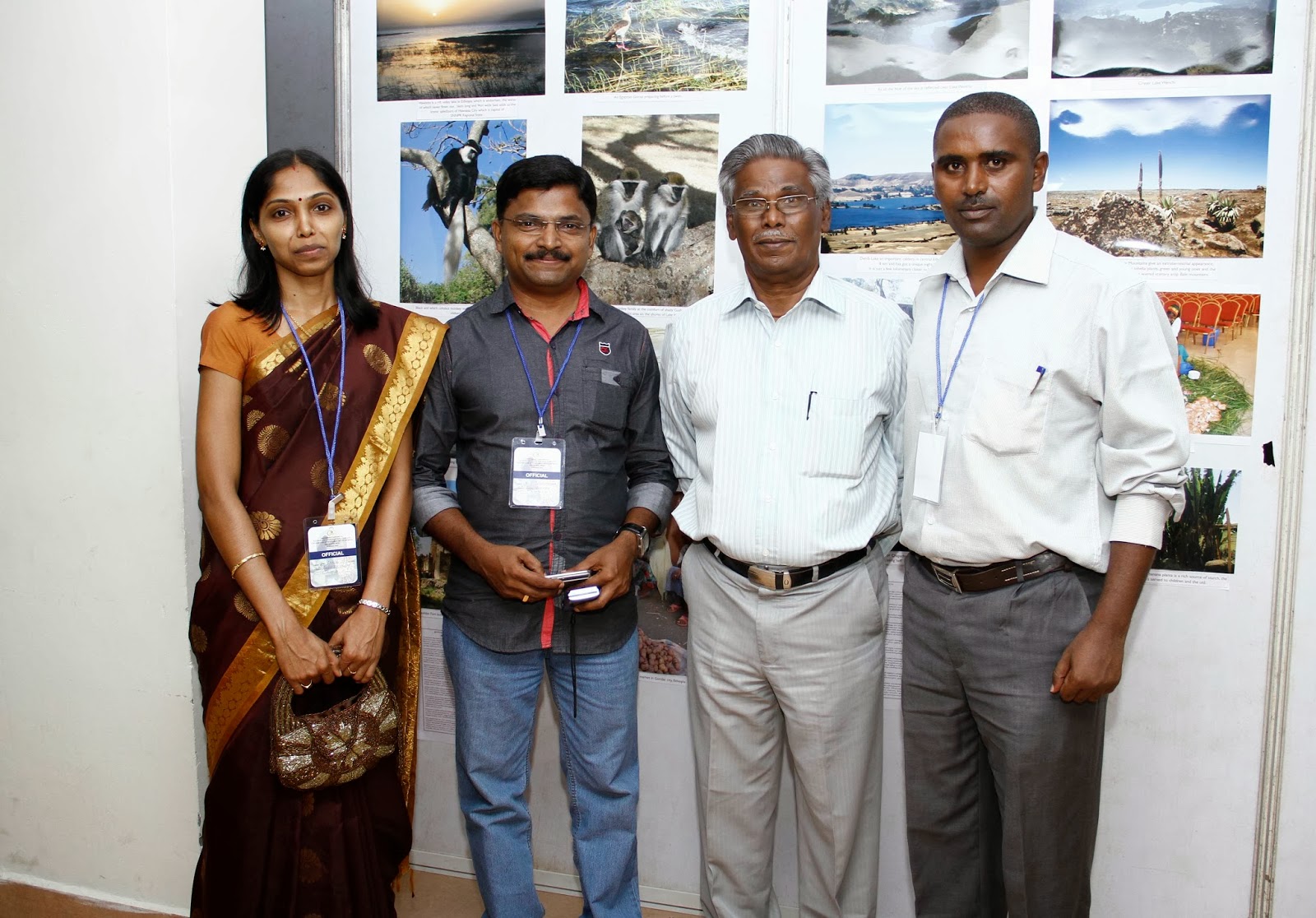
Photos speak: At the exhibition of Ethiopian photos, Mengi joins the organizing committee chairman of ECOCASD 2013, Prof. P. Natarajan (second right), K.P. Sivakumar whose photos are on display and Dr. Akhila S. Nair. 
Mengi is not bad in fast-paced neck-dances of Ethiopia. Still, on the starting night in Kerala, he was dumbfounded by the Duryodhana Vadham Kathakali performed by Kalamandalam Krishnaprasad and team. Captivating him was the throbbing traditional percussions of Kerala’s famed folk art. The characters of the play - smiling Krishna, strong Bhima, spiteful Dussassana and cruel Duryodhana - were all leaving Mengi breathless. Though eating raw meat is a pride custom for any Ethiopian, Mengi was taken aback at the grotesque sight of Bhima pulling out the blood smeared intestine of Dussassana. Immediately after the play, Mengi sneaked into the green room and managed many snaps with Sri Krishna.
He has also made an oral presentation on communication and small scale entrepreneurs at the ECOCASD 2013. After attending a parallel seminar on Biodiversity at Sree Ayyappa College for Women, Nagercoil, he had a visit to Kanyakumari. At the peninsular tip, Mengi who hails from a landlocked nation saw not just one, but three seas joining together. And that definitely has become a matter of lifetime amazement for him.
The ECOCASD 2013 had over 500 participants from all over the world. Among them were renowned scientists, teachers, researchers and students. Ambo University of Ethiopia, that conducted the first leg of the event in 2011 was also backing the event.
- K.P. Sivakumar

Friday, April 26, 2013

Books's Face 1: A Phoenix's call at unwanted children


Chinese Cinderella
Childhood recollections by: Adeline Yen Mah
Publisher: Pearson Education Ltd.
First published: 1999
First educational edition: 2002

Source: Library, Ambo University, Ethiopia

Courtesy: Ms. Deepsikha Saikia, who lent me the book and patiently waited for long before I return.

17th century Cinderella is an Italian. We change this notion while reading Adeline Yen Mah’s ‘Chinese Cinderella’ - a book that is not only an account of her childhood miseries, but also a handbook on Chinese history, language and literature. Mah’s self portrayal of her childhood agonies and stiff sessions of seclusion are heart rendering. Rightly, she has dedicated the 1999-published book to ‘all unwanted children’.

Adeline turns a Chinese Cinderella once her father makes a second marriage and the couple begins making an unfair distinction between the previous children and their own children. Soon after giving birth to Adeline, her mother died. Father remarries. In her life she couldn’t even see a photograph of her real mother. Consequently the little child falls prey to a superstition. The child was believed to have bad blood that must bring only ill fate to the family. This brought huge extortions and pain in the life of a budding girl. Between 1941 and 1951, i.e. from the age of 4 to 14, she had more abominable things to recollect than adorable ones.

Constantly loving Aunt Baba, gracious grandmother, Nai Nai and generous grandfather Ye Ye were shades of solace. Instead, stepmother Niang and Father only sowed seeds of pain in the tender heart. Her siblings were but miserably influenced by the malice spread by the parents.

Success, achievements and celebrations are untold for a Cinderella, testifies Adeline’s life. Love, care and consideration are exclusive rights of children, except of Adeline’s sort. Scarce privileges and salubrious life experiences are only a mirage for children like Adeline whom parents consider unwanted.

Cities of Tianjin, Shanghai, and Hong Kong have contrast differences. But all these cities gave single bitter experience for Adeline: secluded boarding life, pitifully uncared by any elder from home. No letter, no egg, no special food, and no visitor – she had nothing to expect from home. School for Adeline was thus a lone asylum of dreams and pleasures – created by her and enjoyed by her.  During vacations, while she used to be the only girl unclaimed by parents, empty dormitory beds looked like scary rows of tombs. Still, instead of getting stuck by the dismay, the little girl spends her lonely hours in libraries simply to be engulfed by King Lear-kind of Shakespeare or Sara Crewe-kind of Frances Hodgson Burnett.

Prior to a play-writing competition when a disinterested Adeline told “I’m afraid of losing”, Mother Louis suggested, “Anyone who enters has a chance. However, if you don’t enter, then you certainly have destroyed your chance before you even begin”. When she was dejected for not hearing for over six months from the play-writing competition board, Mother Louisa tells her: “Be patient. No news is good news. As long as you don’t hear, you can keep on hoping […]”. As a child, Adeline had exceptional ability to identify and imbibe from the elixir contained in such elderly words.  She was blessed with a trait to understand the ‘talisman power’ of such words. That must be the secret virtue that made her emerge as the country’s first winner in an international English play-writing competition at the age of 14 and later anchor herself on the victory stands of life. This single aspect can alone motivate readers regardless of age and sex.

While concluding her own Cinderella-like experiences, she compares herself with a Chinese Cinderella named Ye Xian whose legendary story was prevalent during Tang Dynasty of 7th and 8th centuries. Ye Xian was loathed by her stepmother, but later emerged a shining star fighting life with sheer determination, hard work and optimism. Through her book Adeline introduces the same genre of phoenix inherent in her. The Adeline Phoenix should certainly kindle a flame of determination among all unwanted children in this modern world.

Adeline has made an admirable selection from the piles of her childhood reminiscences. She could arrange those memory blocks with a cherubic care to make an impressive ‘Chinese Cinderella’. While turning page after page, readers receive an irrefutable soft touch of a petite innocent girl. Line after line, she tweets charmingly the tale of a girl child who was nobody, but later becomes somebody – story of a girl spinning herself a life of dignity and delight against rudely abrasive abashments.

As readers finish reading ‘Chinese Cinderella’, they are gifted with a treasure trove of optimism. A clear insight upon the China of 1940s and 1950s, the wars won and lost and captivating aspects of Chinese calligraphy are just a bonus.
- K.P. Sivakumar

Tuesday, March 6, 2012

Wondrous Wenchi

Travel experience of visiting noted African crater lake, Wenchi, 35km off Ambo, Ethiopia.


Wenchi crater lake - a distant view. 

When in Ethiopia you are on the bosom of Abyssinia – part of the world that bears the glory of giving birth to first human race. It was from here nomads scattered to different locations reaching even to the farthest of the south east Asia. This, of course is a fact that ratifies the resemblance seen between south Indians and Ethiopians.  What you will not see among south Indians is the atypical African curly hair Ethiopians have. Having stayed for nearly a year in Ambo, an Ethiopian highland town with village ambience, it was our ardent desire to explore the natural splendours of this engrossingly ethnic African country.
Entourage: (From left) Dr. Akhila S. Nair, Dr. Salma Zuberi with baby Ruben, Astrid van Agthovan and Amel; Dr. Masud Ilahi, Prof. M.I. Zuberi and author. 

In Ethiopia to decide upon a tourism destination is always puzzling. There are plenty of places that a curious visitor can endeavour upon. If the Blue Nile and Lake Tana beckon you from the north, you get an irrefutable call from the sprawling Bale Mountains in almost the middle of the country. Bale mountain ranges carry yet to be unravelled relation between Himalayas especially in its formation and opulent fossil reminiscent. When you leave the Capital City, Addis Ababa – considered as the world’s third highest Capital from the sea level – towards the west, you reach our town Ambo, at a distance of 120km. The road connecting Addis Ababa and Ambo is an asphalted spiralling one, but without any potholes or bumps. Thanks to the Chinese whose graciousness it is.
Author with driver Abera (left) and Teklu (centre).
You will definitely enjoy a ride from Addis Ababa to Ambo, a two-hour-long one that unveils before you the undulating topography. Nothing obstructs you from seeing unto the horizon. The well-built road unrolls like a black ribbon – looking tapered from far and widening as you approach. On both sides of the road you find traditionally built houses with roofs thatched with grass. The walls of the houses are mostly made of soil paste filling the gaps of wooden logs. This structure, according to natives have long endurance.
The highland climate of Ambo has a characteristic scorching heat outside but salubriously colder inside. Even under a small patch of tree shade you enjoy the cold of breeze, but beyond there, you will find bearing the intensity of sunlight very difficult.   
Ambo fame
Ambo is famous for three things: quality of the natural mineral water, natural hot springs and Wenchi, the crater lake just 30km away. Our fantasy for Ambo mineral water was already satisfied with litres of it we have consumed. Ambo mineral water is noted for its international quality, popularity and export. The manufacturing unit is just 10km away from our residence. And the hot springs – it is on the banks of Huluka River that is the town’s shining necklace. These hot springs had even fascinated the Kings of Ethiopia who used to frequent the town for enjoying a celestial bathing experience. Now the portion of the hot springs is controlled by a privately owned Ambo Ethiopia Hotel, who has appropriately named the area as ‘Paradise Park’. Having experienced mineral water and hot springs, only thing left before us was the magnificent volcanic lake, Wenchi.
Climb up this hill to have a first and distant view of Wenchi.
We shared our Wenchi dream with Prof. M.I. Zuberi, who is a Bangladeshi professor of Environmental Sciences with the Ambo University. He was so excited and started offering more tempting facts on the lake. The mounting enthusiasm was then transferred among the professor’s wife, Dr. Salma Zuberi, a plant scientist; his younger brother, Dr. Masud Elahi, a hydrologist and his Dutch wife, Astrid van Agthoven, who is station manager of UNICEF in Tanzania.
Thus formed was an ambitious team to visit the crater lake. But before setting out for the expedition, we had to wait till Christmas season for Dr. Elahi and Astrid to join us. We were in fact anxious about their 4-yearl-old girl Amel Elahi and 5-month-old baby boy, Ruben. How will the toddler and her baby brother face the trials and tribulations of a trekking through a challenging environment? But the couple were firm and confident. Let the buds start learning life very early, was their theory.
Amel and Ruben: Tender footprints on the banks of a big lake...
So the team is ready. Now who will guide? Our enquiry ended at Teklu – a young, newly joined instructor with the Biology Department of the Ambo University. Taklu had his PG from Addis Ababa University and had his dissertation in biodiversity under the guidance of an Indian professor, M. Balakrishnan. The youngster was really possessed with a mind inclined to investigating more on the biological diversities. Taklu managed to get Abara, a young driver with an omnibus for our journey. My wife, Dr. Akhila S. Nair and Prof. M.I. Zuberi got their leave granted from the university.
Tuesday trip
It was a fine Tuesday. At 7.45am we reached Hotel Keeberoon opposite to the University to pick Dr. Elahi, Astrid and their children. In the previous night, like all other hotels around, this hotel too had the upbeat pomp of a pub – drinking, meeting, eating, dancing… In the morning it is a quiet, decent place with well set seating arrangements. Gentlemen with overcoats are seen seated comfortably and enjoying ‘daboo’ (bread), ‘Injera’ (thin circular staple food made of locally opulent ‘teff’ flour. Injera for Ethiopians is like ‘Dosa’ or ‘Chapati’ for Indians). “We had bread, scrambled egg and Amel took two boiled eggs”, Dr. Elahi said. He had a bag containing bottled water, bread and banana fruits. Yes. We should carry enough water and food while going to Wenchi. Visitors to the lake have to walk for two long hours downward to reach the shore and another two hours upward to reach back the upper station. Vehicles are not permitted, but one can hire a horseback – but no horse cart, please.


Driver Abara and Taklu positioned on the front seats. We were also seated at our convenience. The Omnibus had 13 seats with double seats on one side, single seats on the other and folding single seats through its aisle. A jerk and the vehicle started moving.  A brief stop at the fruit shop – it’s for procuring some bananas for Abara. When everyone goes for trekking, he has to sit alone in the vehicle for hours together.  “What did you buy?” I asked and Taklu said “One kg of development”. “Development?” “Yes, in our language ‘bedana’ means development. Banana and bedana sounds similar” Taklu laughed. Everyone laughed at the fun behind the homophonous words. The vehicle passed Ambo Micro Business College and turned right to take a road opposite to the telecommunication office. Our monthly travels to Addis Ababa and back has been through the straight road. But now a different turn. New experiences begin here.


(Below) Gravel road to Wenchi.

Even though there was tarmac, the surface was not as smooth as the one leading to Addis Ababa. We felt shaking. Two kilometres passed and there was a gathering of people. It was a ‘gaba’ (country market). One more kilometre, and the tarmac ended. Ahead of us was a dusty, gravelled road with rolling pieces of stones. When vehicles pass, there is a cloud of dust and triggering of stones in all directions by the wheels.
We were experiencing truly village ambiences. Children waved their hands from their huts. Some huts were too dilapidated. Some were as if abandoned. “No. there are farmers residing. They might have gone for farming”, Taklu’s comment was in true ratification of the pastoralism prevalent in Ethiopia. Along the road, some equestrians showed their skill by riding their horses faster. Some trailed behind our vehicle.
Love at first sight


Farmer turned tour guide, Wolesso pointed to Wenchi, giving our eyes the first majestic sight.
Abara stopped the vehicle. On the left there is a steep hill and on the right, a deep gorge. “This is ‘gaara’. Climb up and watch Wenchi lake from distance” Abara asked us. “Gaara?” I could not get the Oromo word. “Gaara means hill. Visitors to Wenchi lake climb up this hill and get their first view of the whole lake from the distance. Let us go”, Taklu made it clear. Some of us were a bit confused as to what should be done first – climbing the hill or taking a snap with magnificent valley as background? “No. we will take photos from down latter. First we climb up”, Taklu insisted. When we started walking upward, a local person joined us and started voluntary help. “This is good way”, “Don’t go there” he started guiding us. “Maqaa ke enyu?”, one from my feeble stock of Oromo language to get the stranger’s name. “Wolesso”, he answered. Then my question on his age: “Umri?” Answer: “soddoma” (thirty).  Wolesso was a local ‘kothabula’ (farmer) turned tourist guide. His behaviour and body languages were impressive. He became our friend quickly. He plucked bunches of leaves from a bushy plant that were growing lavishly in the hill and gifted to us. Its aroma was refreshing and rejuvenating. Gents reached the top first and ladies a couple of minutes later. At the peak, Wolesso pointed to a distant place. Wow!! There is Wenchi lake in all her beauty. She shined like a blue pearl encircled by a black and greyish ridge. The sight was amazing. That was our first visual experience of a crater lake. “Magnificent” “Wow! Beautiful” “Marvellous”, commented each one of us. We were searching for the best word to describe the fascinating scene. Our cameras blinked their eyes to catch the images of the beautiful lake.  We descended. Down near the vehicle, Walesso, his wife, Birkkee; three girl children, Radio Direbe, Bashannano, Kabbanese waved hands to us. The farmer-family’s baby boy, 6-month-old Gammada threw a hidden smile for us.
Beauty of the hilltop from where we first saw the beauty of the volcanic lake.
Eco-tourism
Children who gathered in front of the WETA office. 

After two hours of travel through golden yellow farms of barley and teff; and the violet of potato flowers, our vehicle came to a stop near the sign board of Wenchi Eco-Tourism Association (WETA).  Local children encircled us with flowers – fresh and dried ones. Their mission was to sell them to us and get one or two Birr (currency of Ethiopia). Some children needed our pen. Their innocent faces were dotted with dust and flow from the nose.  We felt pity of them. But the officials of the WETA requested us not to encourage them. “Because if you give, their parents will not allow them to go for education anymore”, was the rationale one of the guides had.

WETA is an admirable initiative with people’s participation. Its office had a traditional ambience. It was on the right side of the road on an elevated place. The office was built of soil and wooden logs. There were wooden doors and windows. The roof was thatched with metal sheets – one of the common sights in Ethiopia. On the rear side there was a local type of latrine. It was nothing more than a pit covered with pieces of wood with a hole in the centre. Pieces of plastic sheets on four sides hardly covered the place. But in the native scenario, this is nothing unusual.
We met four young official guides there – Dawit, Fayera, Kebede and Ayale. All of them were nicely behaving and had the readiness to serve the visitors. Their limited competency in English language, was but enough to satisfy curious inquirers.  WETA office works throughout a week. A handwritten poster vividly showed the rate of inflow of tourists, countrywide visitors, and the income generated. The approach of the WETA was enough to give us an impression that things are rather transparent.
Taklu and Prof. Zuberi had serious deliberations with Fayera, the WETA official on the trekking, boating and things of interest with Wenchi.  We hired one horse for the toddler girl Amel to use. Then a to and fro boating for visiting an island was also reserved. All payments had to be made with the WETA office. 19-year-old Kebede joined us as an official WETA guide. Our vehicle could move only one more kilometre from there. From there onwards no more permission for automotives. On the right side of the vehicle stop point, was beautifully built cafeteria of Ambo Abebech hotel. It is a place for the travellers to sit and relax. Earlier there were a dozen of traditional huts for the overnight stay of the visitors. They are almost abandoned now. On the left we had our second sight of Wenchi lake. Now she is a bit closer. Awe inspired by the sight, we started trekking.
Trekking experience
Amel and Dr. Salma Zuberi seated on the horses named Magal and Buzu; and others walking. Payment for the extra horse should be paid to the official guide. Baby boy Ruben found a comfortable seat on a baby-carriage mounted on the back of his father, Dr. Elahi. The dusty pathway was full of rubbles and loose soil. Till the lake, it is almost a downward trail. Literally there was no chance for a trekker to be absentminded or careless. Cost of absentmindedness, as I had experienced once, was a free fall and then a slide down a few feet forward! I expected breaking of my back, but I was bit lucky. Thanks to a couple of feet thick bed of fine dust! I got my specs immersed in the dust.
As you walk down, majestic sceneries unveil before you. During entire span of your trekking you find steep mountain on one side and deep valley on the other. Mountains and valleys are covered with flora of diverse colours and varieties. In the valleys you find barley cultivation. Ethnic vegetations, like Hyginia abyssinica a tree covered with green leaves and red flowers, give you a refreshing break under their shade. “Essence of this tree, seen only in Ethiopia, is used for curing intestinal problems. Hence the name, Hyginia abyssinica”, Taklu explained. ‘Colobo’ monkeys with black and white hair gestured at us. I glanced only once at them. Who wants to look at monkeys and fall down?
At many places mountain surfaces are exposed – a clear evidence for soil erosion. “Erosion takes place even due to wind because of the loose and dry nature of the soil” Dr. Akhila commented. Pointing to the rings of layers found on the exposed mountain parts, Prof. Zuberi said, “See this is a layer of clay, this is a layer of pebbles. White patches indicate calcium”. According to his observation, all these mountains were once submerged under water. “Layers of this kind could be formed only due to sedimentation under water”, he says. 
Two-hour-long trekking accompanied by an Environmental Sciences professor and hydrologist was thoroughly enlightening.  After each stunning sight they would comment something that would inspire your thoughts. Thousands of years back a huge volcanic eruption occurred. Hot lava flowed for a long time. Whole place and its surroundings were boiling! Once everything was cooled down things started settling down. Lava created rocks. Mouth of the volcano turned into a ridge with rainwater collecting inside. No way to run out, the water has been staying there stagnant. The quantity of water and the frequency of replenishment by rain are very large so that the usual problems with stagnant water are not applicable for crater lakes. Magnificent truths – I thought.
On the way, we found four tourists from China. They were so delighted to know that we were from India and Bangladesh. “China and India are friends”, shrugging, one of them said. During our downward trekking, wherever we got a chance, we competed each other to get the best snaps of the lake. After two hours, we were on the shore of the majestic lake. There were not more than a dozen of tourists and a couple of boats on the shore.  The shore was also spotted by a lone building. When you look from outside, inside of the building is perfect dark. I went inside and saw some people sitting on wooden chairs and chatting. Grass leaves were scattered all over its floor to form traditional carpet – an indication that something auspicious a meeting it was. It was a meeting of the local boat owners, our guide Kebede said.

Sailing on celestial waters
Now, time for boating. There were two small open boats near the shore. One was with wooden body and metal covering inside. The other was smaller fibre boat with two oarsmen. We were led to the smaller one. “What is the seating capacity?” I asked. “Six” replied one of the oarsmen. We are already eight including official guide and it is 10 if we count oarsmen also. Amel and baby Ruben are extra. This arithmetic was enough to switch on my water phobia. As the boats moved, it was celestial a beauty unfurling for us. What a beautiful world the almighty has created! We never blinked our eyes, but kept our camera lenses blinking and blinking.  At the middle of the lake, one of the oarsman, Asfa Meconin shared his acquired knowledge: “Here the lake is 75 metres deep”. Everyone was thrilled at the fact. To me it was an inconvenient truth.  After a few minutes we reached the island.
Nestled on the bosom of a pristine crater lake 3380 meters above the sea level, the island was so tranquil. There was a trail through the woods. It ended at a Christian monastery. The church was closed. “This church opens only if devotees come”, Taklu said. Nobody stays there – even not the priests. The island is owned only by birds and trees. Here silence is the hallmark and peace of mind is a gift for every visitor. We sat down on the grass-covered terrain, against the lake. Birds started singing songs to entertain us. Every one of us felt so tired and wanted to eat something sitting on this heavenly piece of land. Oarsmen Asfa and Abeta joined us. “If you want we are ready to boat you a full circle around this island”, Abeta put forward an idea. Everyone endorsed it, even me. But Astrid wanted to sit lonely and feed baby Ruben. “Is it safe for her to sit here alone?” Taklu asked the oarsmen. “Definitely, there is no problem for her. She will be safe”, WETA guide Kebede assured.
We had one full round sailing of the island. It was even more beautiful and captivating. Submerged plants played hide and seek around our vessel. Water sparkled like jade. “Deep colour of the water shows that the lake is too deep”, observed Dr. Elahi The ridge around us stood aloft with all its grandeur and multiplicities of colours.  After a round we joined back Astrid and Ruben on the island. Astrid was sitting on an old log of wood and on her lap was a sweet smiling Ruben. Which baby on this earth dislikes scintillating beauty of nature!
Time for go back. There was a fern-covered old tomb. Mounted on it was a black and white image of the deceased throwing a frozen but friendly smile to us. Rest in peace! We got into the boat – this time the wooden one. There was a new traveller. He wanted to take a photo of him sailing the boat. When he attempted to get the oar, the boat tilted a bit.  Island of monastery went far and far away. Approaching was the shore showing us the way back. During return trip Akhila also needed a horse. Three ladies on three horses and we followed. “Cow girls!” someone commented. Hiking was still more difficult. We took intermittent rest, drank plenty of water. Reached back the vehicle stop point. Had one more view of the Wenchi lake. At 3.45pm she was more bluish. The entire blue sky was reflecting over her body. She is beckoning.
- K.P. Sivakumar